Pilates Muscle Activation: EMG-Based Equipment Comparison
By Keiko Tanaka • 21st May
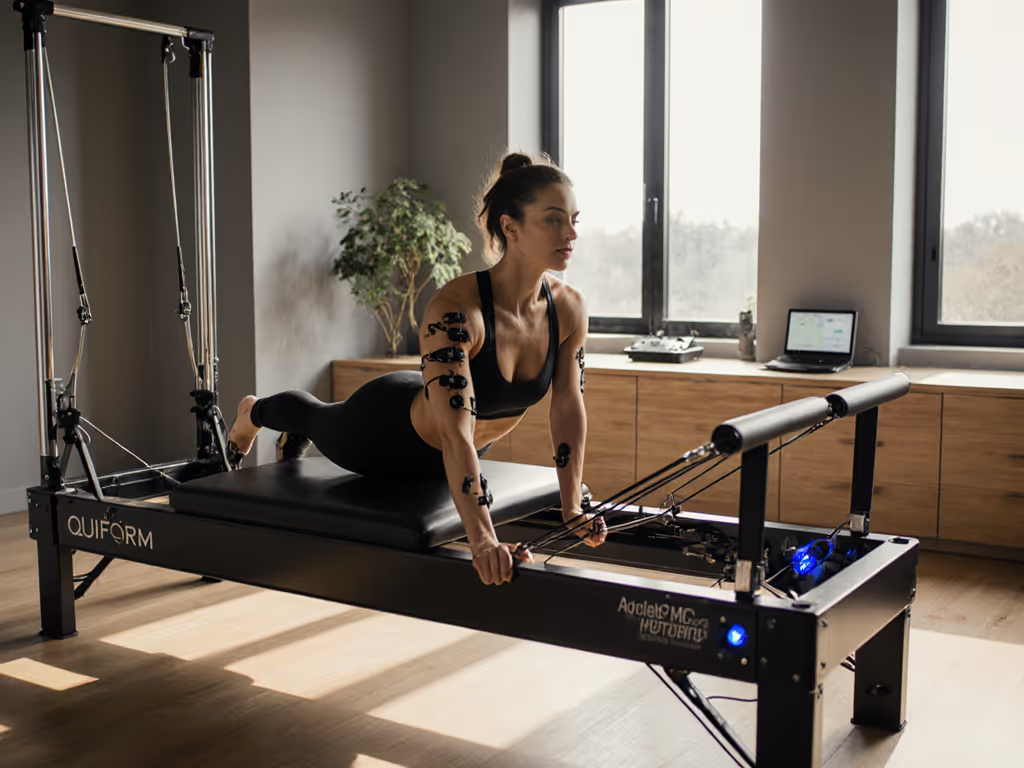
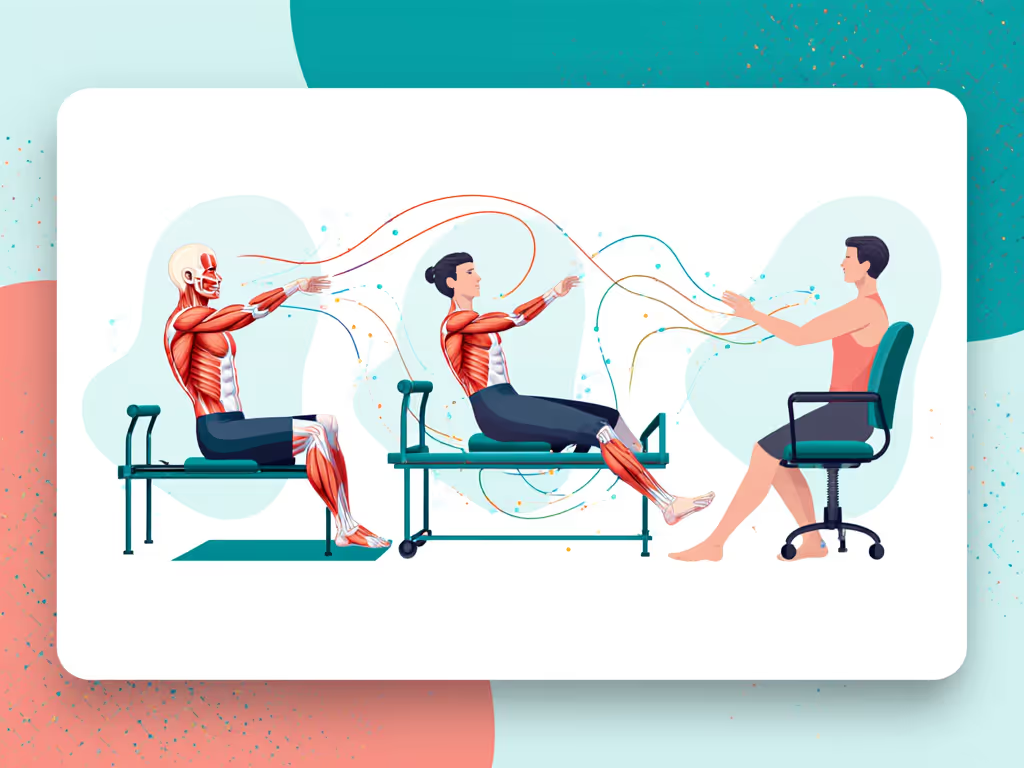
Pilates muscle activation is finally being quantified with real numbers, and EMG-based biomechanics equipment comparison is shifting how we think about what "works." Instead of guessing which setup "feels harder," we can look at measured core muscle engagement, gluteal activation patterns, and postural muscle recruitment across mat, reformer, chair, and unstable bases, then pick the gear that fits both your body and your apartment.
For people in shared buildings, there's an extra constraint: strength has to live inside a small, quiet footprint. My lab work usually focuses on decibels and vibration, but the same principle applies here: you want maximum muscular return for minimum mechanical chaos.
I think in terms of net-quiet score: how much useful activation you get per square foot, per minute, and per unit of equipment fuss.
Below, I'll walk through the most common questions I hear about EMG in Pilates and what the research actually shows about different equipment.
Why use EMG to compare Pilates equipment at all?
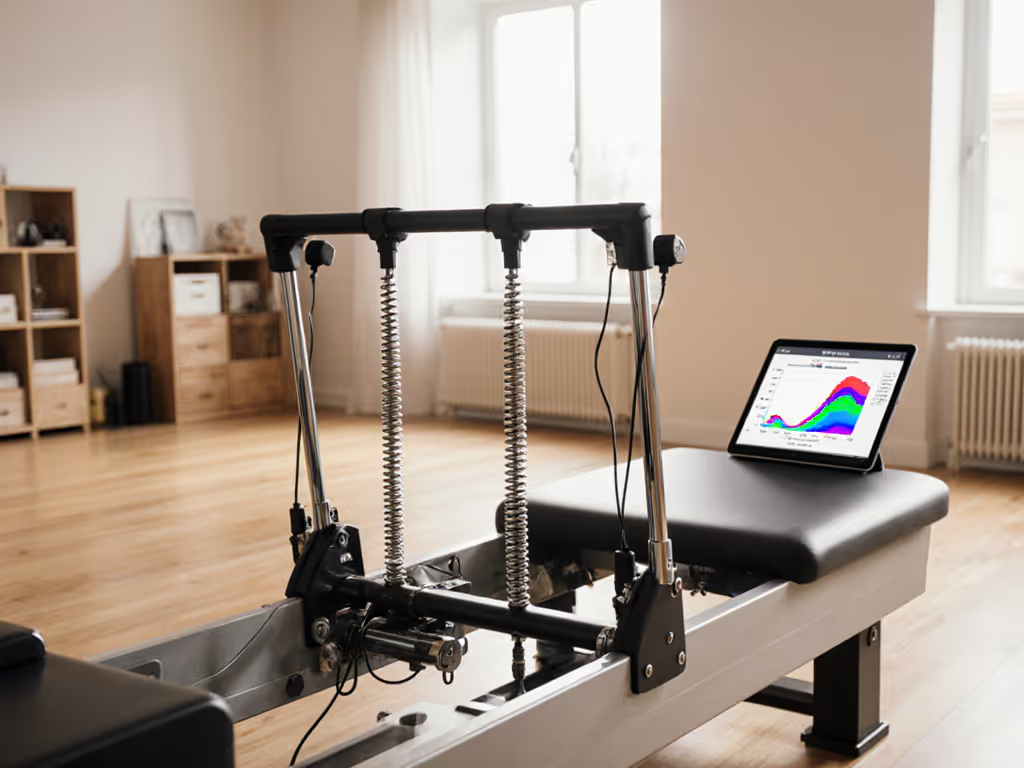
Electromyography (EMG) measures the electrical activity of muscles through small electrodes on the skin. In Pilates research, EMG is often normalized to a maximum voluntary isometric contraction (MVIC) and expressed as %MVIC:
- 0-20% MVIC - low-level activation (postural, endurance work)
- ~20-40% MVIC - moderate activation (good for long holds, high-rep work)
- ~40-60% MVIC - high activation (meaningful strength stimulus for many people)
- 60%+ MVIC - very high activation (heavy strength work or near-max effort)
When we compare %MVIC across equipment:
- We can see whether a reformer version of an exercise actually loads the core more than a mat version.
- We can quantify what happens when you move from floor to short box or other less-stable supports.
- We can map which setups emphasize trunk, hip, or postural muscles.
For small apartments or micro-studios, EMG answers a core question:
"What's the smallest, quietest setup that still delivers the muscle stimulus I want?"
Instead of buying everything, you can prioritize the platforms that deliver the most activation for the muscle groups you care about. For apparatus-specific charts, see our EMG-by-equipment comparison.
What exactly does EMG measure in Pilates, and what are its limits?
Metric-first answer: EMG measures electrical activity, not force, soreness, or results. That matters for interpretation.
What EMG tells you well
- Relative activation between conditions (e.g., mat vs short box) under the same testing protocol.
- Timing of activation - when a muscle fires within a movement.
- Which muscles are working hardest (among those instrumented) in a given variation.
What EMG does not guarantee
- That higher %MVIC automatically produces better long-term strength or aesthetics.
- That one setup is "better" for everyone; comfort, joint health, and technique still matter.
- Perfect isolation - surface EMG can pick up signal "noise" from nearby muscles.
Key limitations for Pilates research:
- Most studies use small, healthy samples (often young adults without pain), so we're careful about generalizing to rehab or older populations.
- Protocols vary (different spring settings, tempos, cueing), which is why I focus on consistent patterns across studies, not single data points.
- Surface EMG underestimates deeper muscles (like some fibers of multifidus), though it still tracks overall postural muscle recruitment reasonably well.
So when I talk about equipment below, read EMG as a load indicator that complements, not replaces, your own joint comfort and control.

How does muscle activation differ between mat and reformer work?
Typical pattern from published EMG data and biomechanics logic:
- Mat often produces high trunk flexor activation because your bodyweight is the main resistance.
- The reformer changes the load curve with springs and moving carriage, sometimes increasing hip and postural demand even when trunk EMG is similar or slightly lower.
Core muscle engagement: mat vs reformer
For classic moves like Hundred, Roll-Up, and Teaser:
- Studies show rectus abdominis and obliques often registering in the moderate-to-high range (~30-60% MVIC) on both mat and reformer.
- In some protocols, mat-based versions show slightly higher rectus abdominis %MVIC, especially at more challenging lever arms (legs extended, no spring assistance).
- Reformer variations tend to shift some load into hip flexors, glutes, and deeper stabilizers, particularly when the carriage is moving and springs are set light.
What this means practically:
- For pure trunk flexor strengthening, advanced mat work can be as demanding, or more demanding, than many reformer setups.
- For integrated core with hip and shoulder demand, the reformer's moving platform provides richer coordination and stability challenges.
Net-quiet angle for apartments
- A mat plus a few small props (ball, ring, light weights) can deliver meaningful trunk EMG levels with zero mechanical noise.
- A well-built reformer adds motion and variety, but introduces potential spring noise and floor vibration.
If you're noise-sensitive or in a thin-floored building, a mat-first approach with selective reformer sessions can keep your net-quiet score high while still challenging the core. If you're considering motorized options, compare electric vs manual reformers for real-world noise and space trade-offs.
What do short box and unstable bases do to trunk activation?
The study you saw in your search results ("Electromyographic evaluation of trunk core muscles during Pilates exercise on different supporting bases") compared the same Pilates exercises performed on different supports, including a short box.
Key finding (simplified):
- Using the short box significantly increased %MVIC in both rectus abdominis and internal oblique compared with more stable bases.
- Across conditions, less stable support surfaces produced higher trunk muscle activation.
This aligns with broader EMG literature on instability training:
- Shifting from a stable to a slightly unstable base can increase trunk muscle activity by roughly 20-40% in some exercises, a fact echoed by multiple core stability studies.
How far should you push instability?
Evidence and experience both suggest a sweet spot:
- Mild to moderate instability (short box, foam pad, small ball) tends to boost core engagement without wrecking form.
- Extreme instability (large Swiss ball for complex moves, very wobbly surfaces) can reduce movement quality and shift effort into "not falling over" rather than targeted muscle work.
For Pilates muscle activation, the short box is a high-yield tool:
- Increases trunk EMG without needing heavy springs or extra load.
- Packs small, stores vertically or under furniture.
- Adds almost no additional noise, so it doesn't change your apartment sound profile.
If you want more core without more equipment footprint, a short box or similar modestly unstable base is one of the highest-efficiency upgrades. Short boxes and other add-ons are covered in our quiet reformer accessories guide.
How do different setups affect gluteal activation patterns?
When we look at gluteus maximus and medius across Pilates equipment, EMG data and mechanical reasoning converge on a clear pattern.
1. Mat-based bridges and side-lying work
- Glute bridges, single-leg bridges, and clamshell variations often show moderate-to-high glute max activation (~30-60% MVIC), especially at single-leg or elevated versions.
- Side-lying hip abduction and clam patterns recruit glute medius strongly, frequently in the 40%+ MVIC range in challenging variations.
Advantages:
- Silent.
- No extra equipment beyond a mat and maybe a loop band.
- Easy to progress via lever length, tempo, and isometric holds.
2. Reformer footwork, leg presses, and skaters
EMG studies on reformer footwork show:
- Glute max activation is highly sensitive to foot position, hip angle, and spring load.
- Heavier springs and deeper hip flexion angles tend to produce higher glute EMG, often in the moderate-to-high range.
- Lateral "skater" or side-lying leg press patterns on the carriage increase glute medius demand due to frontal plane control.
Trade-offs:
- Excellent for integrated hip-knee-ankle strength and control.
- Carriage impact and spring recoil can add audible noise and floor vibration, especially on older wood floors.
3. Chair (Wunda chair) and small props
- Step-downs, single-leg presses, and split-stance patterns on the chair commonly show strong glute max and medius activation, comparable to or exceeding mat work when loaded appropriately.
- Because the base is compact and near the floor, vibration transmission is often lower than a long reformer frame, especially on a good mat.
Apartment / micro-studio takeaway:
- If you want maximum gluteal activation per decibel, advanced mat + band work comes surprisingly close to reformer numbers.
- A compact chair can be a strong middle ground - high glute EMG potential with smaller footprint and generally quieter mechanics than a full reformer.
Which setups best recruit postural muscles for alignment and back health?
Here we're talking about muscles like multifidus, erector spinae, deep abdominals, and scapular stabilizers.
Mat-based postural work
- Swan, Breaststroke prep, Swimming, and four-point kneeling variations show moderate activation in spinal extensors and scapular stabilizers.
- Thorough postural muscle recruitment is achievable with no apparatus, especially when you add lever length (longer arms/legs) and holds.
Reformer and tower-based postural work
EMG data and biomechanics suggest:
- Prone and seated pulling sequences against spring resistance increase activation in:
- Lower and mid trapezius
- Rhomboids
- Erector spinae
- Springs introduce a consistent, direction-specific load, which can raise postural muscle EMG into the moderate-to-high range while keeping absolute load joint-friendly. For a deeper dive into how springs change resistance profiles, read our Pilates resistance science explainer.
Stability vs activation
- Slightly unstable platforms (moving carriage, short box, foam) increase the stabilizing demand on spinal and deep abdominal muscles.
- This often shows up as higher low-to-moderate %MVIC across multiple postural muscles. Exactly the kind of endurance work useful for maintaining alignment over a workday.
For desk-bound apartment dwellers, you don't necessarily need large gear to target postural muscles, but:
- Springs and modest instability can make the work more efficient, especially when time is short.
Does higher EMG always mean "better" exercise?
Short answer: no. EMG is one lens, not a verdict.
When I review EMG data analysis for Pilates equipment, I look at three things:
-
Intensity suitability
- Very high %MVIC is not appropriate for everyone, every day. For new parents snatching 20 minutes at nap time, moderate ranges with good form may be ideal.
-
Movement quality and joint stress
- If a more unstable setup spikes EMG but also makes your spine feel unsafe or your shoulders grip, it's a poor trade.
-
Net-quiet score in real homes
- A slightly lower EMG but much less mechanical noise can be the right call in a creaky pre-war building.
Higher activation is only better if it fits your joints, your goals, and your walls.
You'll see EMG used in marketing to imply "this version is superior." In practice, it's more useful to think in terms of options:
- Want a gentler day? Choose a variation that research shows in the low-to-moderate range.
- Want a strength-focus session? Use setups known to produce higher %MVIC for the target muscles, then keep reps, tempo, and rest honest.
How can apartment and micro-studio users apply this research when choosing equipment?
This is where my testing world (noise, vibration, stability) meets EMG.
Step 1: Decide your priority muscles
- Core focus (rectus + obliques): advanced mat + short box / foam gives excellent activation without big apparatus.
- Glute focus: mat bridges + bands, optionally a compact chair or carefully chosen reformer.
- Posture focus: mat + light dumbbells or bands; tower or reformer if you have the space and budget.
Step 2: Cross-check against your building constraints
- Thin floors / nervous downstairs neighbor:
- Lean toward mat, short box, and small props.
- If adding a reformer, choose one with quiet springs and pair it with a dense rubber mat platform. To keep things silent over time, follow our reformer maintenance guide.
- Concrete high-rise:
- You can usually tolerate a bit more mechanical noise; spring-based equipment becomes more viable.
Step 3: Evaluate net-quiet score, not just features
For each potential purchase, ask:
- How much muscle activation can I reasonably get from this, based on EMG patterns?
- How much audible and structural noise will it add to my space?
- Does it fold, nest, or store in a way that keeps my living area calm?
The best choice is the piece that gives you just enough extra activation beyond what mat work can do, without tipping your home out of its quiet zone.
Some of my strongest client outcomes come from mat-only or mat-plus-small-prop programs in tight apartments. The difference is how intentionally we use the levers and instability, not how big the gear is.
Sample progression paths by equipment level
Here are conservative, EMG-informed progressions that respect both muscles and neighbors. These are not medical prescriptions, just programming frameworks.
1. Mat-only (no large equipment)
Core:
- Hundred variations, Roll-Up, dead bug progressions
- Add lever length and holds to approach moderate-to-high activation safely
Glutes:
- Double and single-leg bridges, hip thrusts off a sofa edge
- Side-lying abduction and clamshells with band
Posture:
- Prone Swans, Breaststroke prep, front support/plank variations
- Band pull-aparts or light dumbbell rows
2. Mat + short box / foam / small ball
You're harnessing the instability effect documented in the short-box EMG study.
Core:
- Seated spine flexion/extension and rotation on short box
- Roll-backs with feet supported but pelvis on a slightly unstable base
Glutes:
- Bridges with feet or shoulders on short box
- Single-leg balance work standing with one foot on the box
Posture:
- Tall-kneeling or high-kneeling arm work with bands while on the box
- Half-kneeling rotations for integrated trunk/hip stability
3. Mat + chair or compact reformer
Add spring-based load while managing footprint.
Core:
- Reformers: long box pulling straps, Short Spine, coordination (moderate-to-high integrated activation)
- Chair: seated or standing presses that couple trunk control with arm/leg work
Glutes:
- Chair step-downs and single-leg presses
- Reformer side-lying leg press or scooter patterns
Posture:
- Rowing series, pulling straps, and tower-like pulling exercises with springs
- Focus on shoulder depression and thoracic extension, not just "arm work"
In every case, scale springs or leverage to stay within a smooth, controlled effort, the same philosophy I used when I first started mapping sound in a noisy building: measure, adjust, verify (quiet that earns your neighbor's forgiveness).
Key takeaways: How to think about Pilates muscle activation in real spaces
- EMG gives you relative, not absolute, answers. Use it to compare setups, not to crown a single "best" exercise for all bodies.
- Mat work is more powerful than it looks. Advanced variations can match or exceed reformer trunk EMG while being silent and space-efficient.
- Mild instability (short box, foam) is a high-yield upgrade. It reliably boosts core activation without demanding heavy springs or bulky gear.
- Glute and postural gains don't require large apparatus. Smart mat programming and small props can approach EMG levels seen in bigger equipment.
- Your building matters as much as your body. Always weigh an exercise or apparatus's net-quiet score alongside its EMG profile.
If you want to explore further, I'd suggest:
- Tracking your own perceived exertion (0-10) alongside which setups you use; over a few weeks, you'll build your own "activation map."
- Rotating in one instability or spring-based element at a time so you can clearly feel what changes.
- Reading full EMG studies when you can - they're dense, but they train your eye to think in data, not hype.
The goal isn't to chase the highest possible muscle activation. It's to build reliable, quiet strength that fits your room, your schedule, and your neighbors, and keeps you practicing consistently for years.
Related Articles