Pilates Equipment Muscle Activation Comparison
By Priya Kapoor • 31st Mar
When I moved my practice into a 400-square-foot studio that shared a wall with another business, I learned something fast: Pilates equipment muscle activation and biomechanics comparison are not academic exercises when your neighbors' peace depends on your equipment choices. Selecting the right gear (one that activates muscles effectively while operating quietly) became as critical as the coaching itself. This guide breaks down how different pilates equipment engages muscles, which setups suit tight spaces and shared buildings, and how to build a reset script that keeps throughput high and noise low.
FAQ Deep Dive: Equipment, Activation, and Apartment-Ready Pilates
What Muscles Does Pilates Actually Activate, and How Does Equipment Change That?
Pilates is designed to engage various muscle groups simultaneously, with emphasis on core strength alongside activation throughout the body.[1] The magic lies not just in movement, but in how equipment changes that activation. Without equipment, you're engaging your own body weight. Add a reformer, and you've introduced spring resistance, a variable that transforms the recruitment pattern.
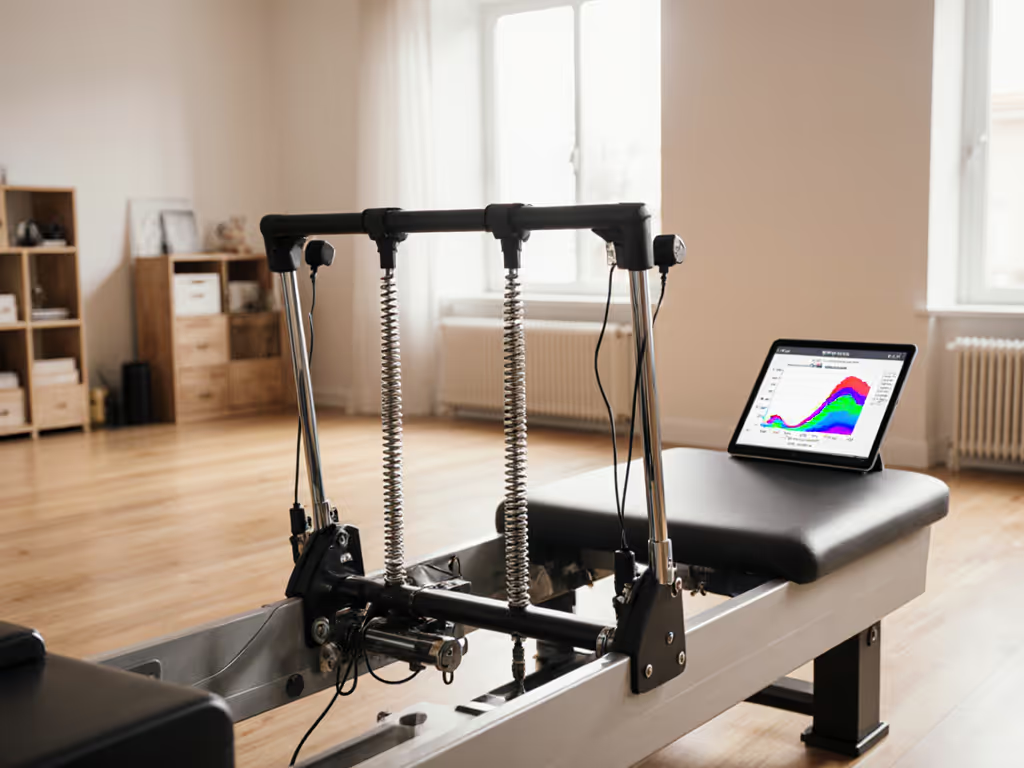
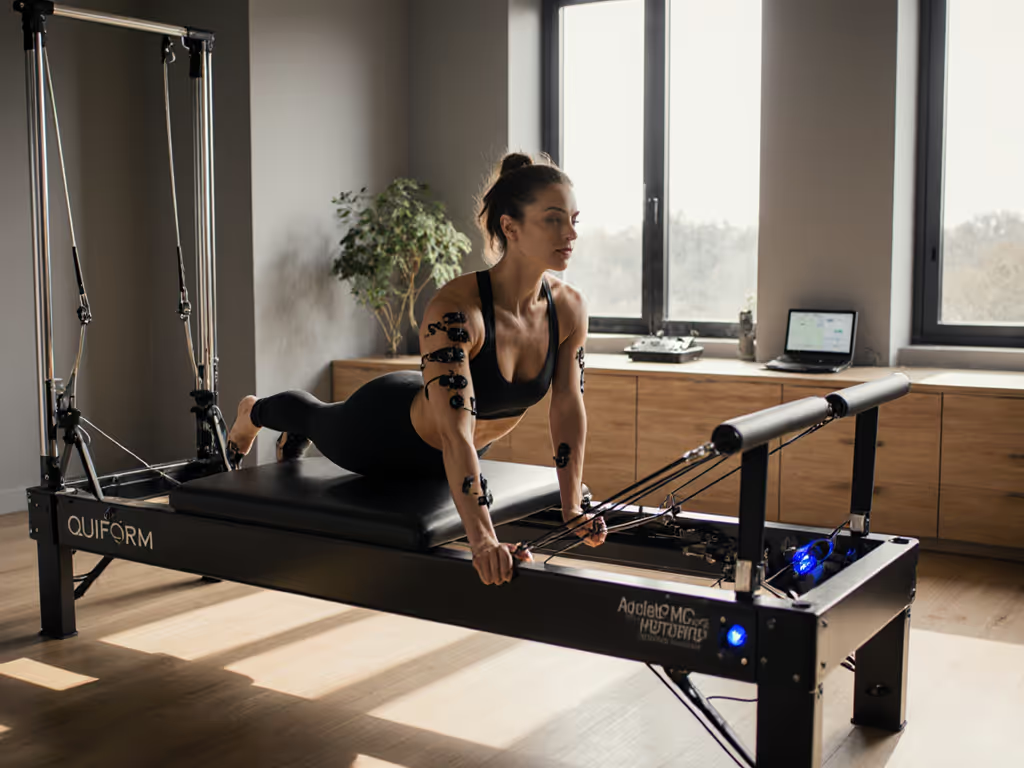
The Pilates reformer, with its resistance springs, creates what researchers call core muscle engagement through continuous tension.[1][2] Unlike a static mat, the carriage moves under spring load, forcing stabilizers to work in real time. Your deep transverse abdominis, multifidus, and obliques fire continuously to control acceleration and deceleration. The reformer's horizontal orientation also changes hip and shoulder loading compared to standing or kneeling work.[2]
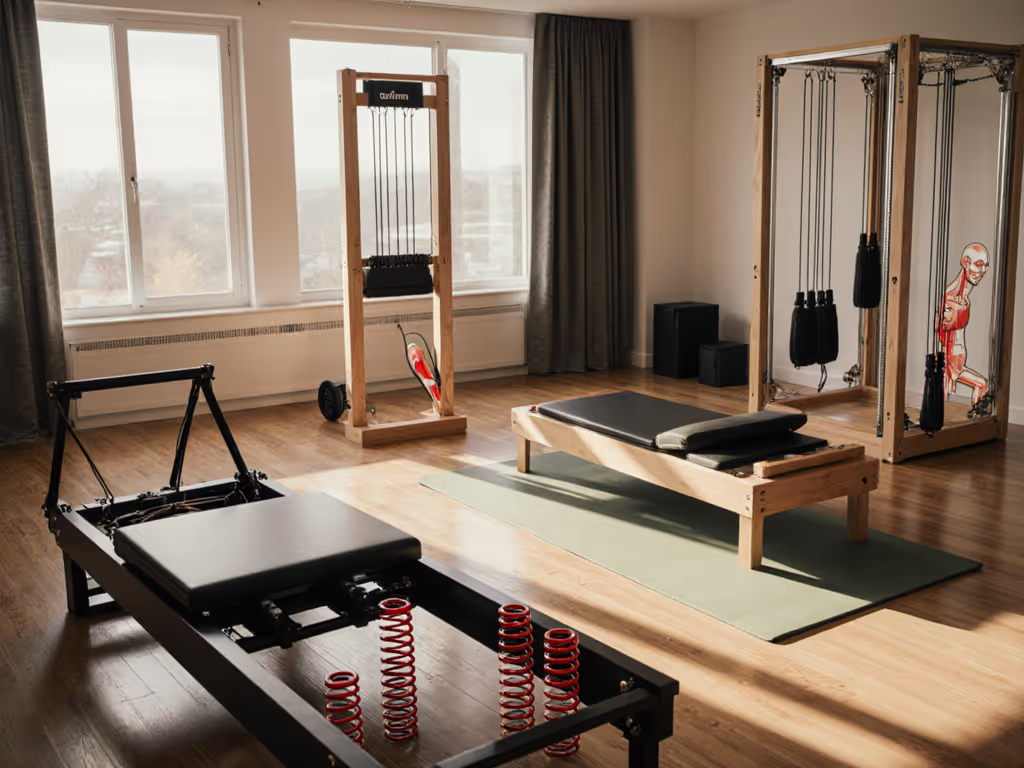
The Cadillac (or Trapeze Table) shifts activation patterns again.[4] Its vertical and horizontal bars allow inversions and suspended positions that load the body three-dimensionally.[4] This recruits different postural sequences (particularly the posterior chain and shoulder stabilizers) than reformer work, because you're managing weight distribution in space rather than pushing against a carriage.
Operational excellence is quiet, predictable, and invisible to your neighbors, and that starts with choosing equipment that stabilizes without thud.
How Do Different Equipment Designs Compare in Muscle Activation?
Research confirms that Pilates increases muscle strength by 27% ± 16 when practiced at an average frequency of 3 ± 1 sessions per week over 12 ± 7 weeks, with particular gains in lower limb and flexibility metrics.[3] But not all equipment delivers this equally, and how they deliver it matters for your space.
Reformers vs. Mat Work:
Traditional weight training builds muscle hypertrophy through heavy external load. Pilates focuses on elongating muscles, creating lean strength, and improving flexibility, making it complementary rather than substitutional.[1] Equipment-based Pilates (reformer, Cadillac) enhances this effect because springs provide variable resistance, which engages gluteal activation patterns and deep stabilizers more consistently than bodyweight alone.[1][2]
Spring Resistance Comparison:
The reformer's springs offer something crucial: eccentric loading. As you resist the spring's return, your muscles lengthen under tension. This isometric component (sustained contraction without joint movement) builds endurance and control.[1] A four-spring reformer distributes load differently than a two-spring version; more springs mean more total resistance but also allow micro-adjustments in difficulty. For a deeper dive into tuning tension and spring choices, read our spring mechanics guide. For tight spaces, this modularity is operational gold: you can dial down spring load for early-morning quiet sessions or ramp up for evening clients without swapping equipment.
The Cadillac, by contrast, uses ropes, pulleys, and body suspension. Hip and core muscle engagement come from stabilizing your position in space rather than pushing against a spring. Research shows Pilates improves lower limb strength significantly when measured against no activity.[3] The Cadillac's suspended positions particularly challenge the stabilizers because they remove the security of a solid base, demanding more gluteal recruitment to stabilize the pelvis.
Which Equipment Is Quietest for Shared Buildings?
This is where the operational calculus gets real. For apartment-friendly picks and decibel data, see our quiet compact reformer guide. You can have perfect biomechanics comparison data, but if a carriage thump disturbs the therapist's office downstairs, you've failed.
Mat work and suspension equipment (Cadillac, straps) are inherently quieter because they lack moving carriages or spring-loaded friction surfaces. A stability ball adds just the sound of gentle contact; a Pilates arc (curved platform for stretching) is silent.[5]
Reformers generate noise through carriage travel, spring tension release, and platform contact. Cheaper reformers squeak because springs aren't evenly tensioned and carriages lack proper damping. Studio-grade machines use precision roller systems and isolating pads to reduce impact. When selecting a reformer for an apartment or micro-studio, prioritize:
- Metal-on-metal runners (smoother than plastic-on-metal)
- Integrated shock absorption or isolation feet (not add-ons)
- Heavy, stable base that doesn't vibrate on impact
- Spring bars engineered for even tension distribution
The Ped-o-Pull (upper-body-focused resistance frame with springs and handles) falls in the middle: springs create tension but no moving carriage, so noise is minimal, just the quiet click of handle adjustments.[2]
What Does EMG Data Tell Us About Equipment Effectiveness?
Electromyography (EMG) measures electrical activity in muscles during contraction, showing which muscles fire and with what intensity. While the search literature doesn't detail EMG data analysis directly, the research consensus is clear: Pilates increases muscle strength and flexibility comparably to other exercise modalities when measured over time.[3] The key variable isn't the equipment type alone but consistency and progressive resistance.
What this means operationally: a modest two-spring reformer used three times weekly will outperform a four-spring reformer gathering dust. The equipment that fits your space, stays quiet, and feels intuitive to reset between sessions is the equipment clients actually use.
How Should I Structure a Micro-Studio Setup for Maximum Muscle Engagement and Minimum Neighbor Friction?
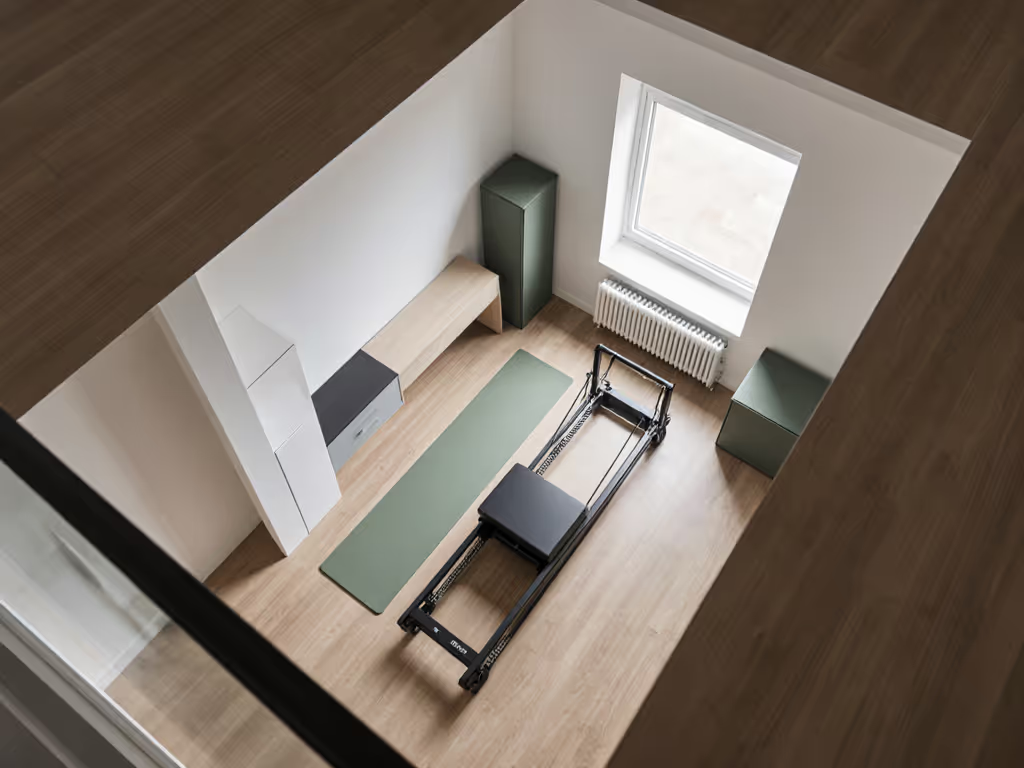
Here's the scenario I've optimized a hundred times: you have 300 square feet, four client hours per day, and a building manager watching decibel counts. You need throughput, variety, and silence. For layout, flooring, and placement specifics, follow our silent small-space studio setup.
Phase 1 (Quietest Foundation):
Start with mat work and a Cadillac or tower (wall-mounted to save floor space). Both allow full-body core muscle engagement and postural muscle recruitment without moving parts. Add a stability ball and Pilates arc for variety. This phase is virtually silent and occupies minimal footprint.
Phase 2 (Controlled Addition):
Introduce one high-quality reformer (studio-grade with isolation feet), positioned on a vibration-dampening platform at least 10 feet from shared walls. This expands your repertoire while maintaining neighbor peace. Your reset script now includes: client finishes, you wipe reformer, move carriage to home position, replace spring bar in neutral state, reset foot bar to standard height. Total time: 2 minutes.
Phase 3 (Accessory Ecosystem):
Add boxes, straps, and springs modularly. Don't layer multiple reformers; instead, maximize single-station flexibility with quick-change components. This keeps footprint constant while expanding variety and (crucially) maintaining throughput because you're not managing conflicting equipment footprints during client transitions.
What Equipment Combination Delivers Strong Results in the Smallest Space?
Cadillac + Mat remains unbeaten for small apartments or micro-studios. The Cadillac's footprint is roughly 5' × 7', wall-mountable, and enables gluteal activation patterns, core work, and upper body strength through suspended exercises.[4] Pair it with a quality mat and your clients access a surprising breadth of work, including planks, core activation, and flexibility, without adding bulk.
Reformer + Cadillac is the dual-station ideal if you have 400+ square feet. Reformers demand floor space; Cadillacs work wall-mounted. Together, they hit every muscle group via different mechanical stimuli while each operates quietly if properly engineered.
Single Reformer + Tower + Accessories works if you're strict about upgrade sequencing. A two-spring reformer on isolation pads, plus a wall-mounted tower (handles and springs for standing work), plus stored boxes and straps. This setup delivers variety equal to a larger studio while keeping your footprint and noise envelope predictable.
Research confirms that Pilates increases flexibility significantly in the hip and lumbar region, with large effect sizes for upper limb flexibility too.[3] Equipment choice doesn't override this, consistency does. But equipment that fits your space and operates quietly becomes invisible friction; you and your clients can focus on practice rather than managing chaos.
Actionable Next Steps
If you're building a micro-studio or apartment practice:
-
Audit your space and neighbors. Measure floor type (wood, concrete, carpet), wall material, and proximity to adjacent units. This determines damping strategy before you buy.
-
Start with silent or low-noise equipment. Mat, Cadillac, tower, stability ball, then build confidence and client base without noise risk.
-
Add reformer equipment strategically. If you add a reformer, invest in studio-grade damping, isolation feet, and a vibration platform. Budget 15-20% of the reformer cost for acoustic support. To keep it whisper-quiet long term, follow our reformer maintenance guide.
-
Design a reset script. After each client, what takes 2-3 minutes to return the studio to neutral? Carriage to home, springs to neutral tension, mats stacked, accessories stored. Automate this sequence so it becomes effortless and throughput stays high.
-
Test before committing. If possible, demo equipment in a space with similar acoustics. Decibel meters are cheap and reveal truth quickly; neighbor feedback is not.
-
Choose modular over sprawling. One excellent reformer beats two mediocre ones. One quality Cadillac beats a closet of half-used specialty boards. Depth beats breadth in small spaces.
Flow that respects tenants next door is real operational excellence. Build that foundation, and your muscle-building practice will scale quietly.
Related Articles